










 STREET TRUCKS STAFF
.
May 28, 2026
.
Industry News
.
STREET TRUCKS STAFF
.
May 28, 2026
.
Industry News
.
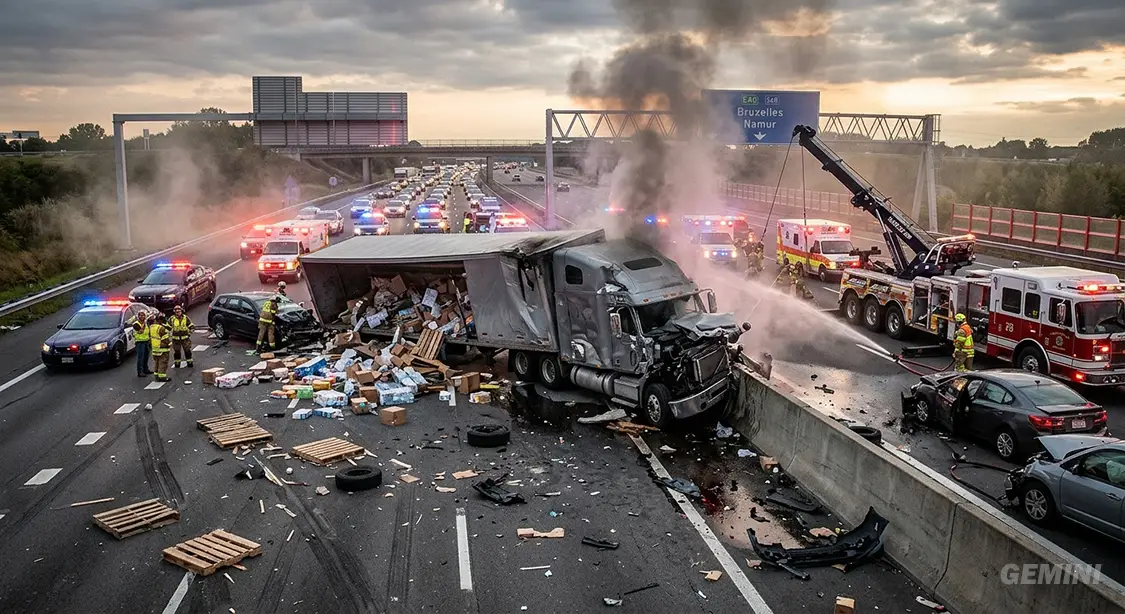
Truck collisions can result in damage to property, serious injury to individuals, and pollution of the surroundings. Most cases result in the victims suffering from severe damage. Unfortunately, as of April 24 in 2026, there have already been 33,300 truck crashes that occurred in the US, according to Consumer Shield.
Truck accidents are categorized among the most hazardous accidents on American highways. An 80,000-pound loaded semi colliding with a 4,000-pound car produces a predictable outcome. The question that establishes liability requires examination of what caused the collisions. This element contains greater complexity than mere bad luck. Many people tend to blame truck drivers for truck accidents right away.
What are the most common ways truck drivers cause accidents? Most truck-related accidents are caused by their drivers. It is important to know that the actions of a truck driver can make him or her responsible for the occurrence of an accident. A truck driver’s behavior is not the element taken into account when finding liability in a truck accident case.
Let’s identify the frequent cause of truck accidents and how they can be avoided.
One of the most common reasons for serious truck accidents is driver fatigue. An exhausted truck driver who operates a truck can take one second too long before applying the brake. This situation can cause deadly accidents.
The federal regulations provide a direct solution to this particular problem. The Federal Motor Carrier Safety Administration (FMCSA) requirements detailed in 49 CFR Part 395 limit the number of hours of service for carrying goods. According to the requirement, the legal stipulation is that drivers must rest for at least 10 hours before they may drive for a maximum of eleven hours. It is mandatory that drivers honor the rest break after completing 60 hours over seven days or 70 hours of work within eight days.
Legal analysts who examined research on fatigue impairment found that staying awake for over 24 hours leads to driving impairment that matches the effects of a blood alcohol concentration at 0.10. This effect exceeds the 0.04 legal limit that applies to commercial truck drivers. The enforcement of regulations prevents drivers from committing hours-of-service violations.
Drivers who need to complete deliveries within short timeframes tend to create false logbooks or change their electronic logging devices’ (ELDs) records. Investigators use ELD data along with dispatch records, fuel receipts, and toll records to recreate the driver’s complete schedule. This analysis will show whether the official log and reconstructed schedule have significant discrepancies. Any inaccuracy in the records can help prove negligence.
When a trucking business designs schedules in which adherence to hours of service is impossible, they promote situations in which drivers are more likely to ignore fatigue signals and violate the hours of service rules. In this case, the trucking company can bear some of the liability for the resulting crash. The truck company is at heightened risk of financial liability as a result of the negligent actions of the driver.
According to the law firm website https://www.danielclaytonlaw.com/, distracted driving is dangerous since it takes a driver’s focus away from safely operating their vehicle and increases the chance of an accident
The driver must be aware that there are prohibitions in place against the operation of commercial trucks in a distracted state. In accordance with 49 CFR Section 392.82, the commercial motor vehicle operator cannot use a handheld mobile phone while driving the vehicle. The regulation defines “use” broadly to include holding the phone to make a call, dialing, or texting. The law establishes civil penalties for violations, which serve as proof of negligence during crash litigation.
Problems in commercial trucking normally arise from distracted drivers who drive while using their phones. Long-haul routes create a situation where drivers become inattentive as a result of the repetitive nature of their work. Drivers use in-cab controls while they eat and study paper route maps or they enter a state of highway hypnosis. Research has shown that these actions can be a real driving performance impairment. Distracted truck drivers exhibit gaps between the time of impact and the period of reaction, which triggers truck accidents.
There are times when certain technical issues can cause safety problems with commercial vehicles, like for example, malfunctioning brakes or issues pertaining to tires or cargo securement. These are the types of situations that result in the drivers breaking rules of the road. According to statistics, truck accidents commonly result from brake loss.
Federal truck regulations mandate that every driver should check their vehicle before trips. Trucks require continuous maintenance throughout their operational period. The carrier becomes fully responsible for all damages when their decision to delay brake repairs results in an accident. Product liability claims against brake manufacturers or component suppliers may also arise when a defect in truck parts rather than deferred maintenance is proven responsible for the accident.
In case a heavy-duty truck is moving at a high speed on a highway and the tire explodes, the driver’s ability to drive the vehicle further is compromised. On some occasions, a sudden failure of the rear tires results in the trailer moving sideways relative to the cab while still in motion at very high speeds, causing what is known as “jackknifing.” This scenario usually results in a crash where several cars have one impact or the other while spanning multiple lands. Like brake failures, tire failures that result from inadequate maintenance or from known defects in the tire product create liability that may extend to the carrier the maintenance provider or the manufacturer.
The regulation from 49 CFR Part 393 controls cargo securement requirements. If the loading of cargo does not meet the relevant regulations, overloading may occur, leading to the vehicle overturning and subsequent load shifts. The drivers will be unable to safely take sharp turns and ready themselves for emergency braking situations. In the event that the cargo is packed unsafely, the blame can be put on the carrier or on the one who accepted or transported the goods.
Statistics show that high speed can cause fatalities during truck accidents more often than any other factor. Fully loaded semi-trailers on freeways at full speed will come to a complete stop in 25 seconds or less, under good conditions. Failing to understand these performance limits can lead to loss of life and serious motor vehicle accidents.
Failure of trucking corporations to conduct proper screening tests on potential drivers before they authorize them to venture into specific territories such as hills, congested cities, excessive negative temperatures, or hurricane weather can be categorized as negligent hiring and training practices. Another instance where the trucking company is made responsible for an accident happens when it doesn’t train a driver on how to deal with the transported cargo without putting the vehicle at risk.
The claims require proof that demonstrates the company’s methods of employee hiring, its training materials, and the driver’s knowledge about the route and load at the time of the accident.
The determination of accident responsibility and applicable legal theories depends on the specific cause of the truck accident. A driver fatigue crash points toward hours-of-service violations and employer pressure. A brake failure connects to maintenance records and product defects. A distracted driving crash points toward the driver’s phone records and carrier policies. A cargo securement failure points toward loading documentation and shipper obligations.
In commercial truck litigation, evidence becomes unsuitable for use after a specific duration. If the crash site electronic logging device data and black box recordings are available to download and the surveillance footage is accessible, the experts can reconstruct the accident within three days. If some crash site data is lost or damaged, some facts will remain unrevealed. The cause establishes the claim. An established claim later on helps a victim’s recovery.



Industry News
The trucking industry never sleeps, as trucks are constantly moving and delivering freight to their destinations. As a result, thousands of trucks can be moving… Continue reading
ST-STAFF . May 30, 2025

Department
Living the Life and Printing the Passion IN THE SHORT AMOUNT OF TIME THAT I HAVE BEEN SPEARHEADING THIS EXTREMELY ICONIC BRAND, EMAILS, PHONE CALLS… Continue reading
Chris Hamilton . October 21, 2018
Features
Having the ability to say you’ve been doing something for 100-years straight is impressive enough, but when it’s been 100 years of doing something like… Continue reading
Chris Hamilton . August 08, 2023

Department
Toyota 4Runner Celebrates Historic Run with 40th Anniversary Special Edition Forty candles. The big “four-0.” The Toyota 4Runner will reach the 40-year mark with the 2023 model year… Continue reading
Mike Self . August 26, 2022

Department
Street Trucks Top 10 from the 20th Annual One Day Slam by Jonathon Hawkins. Even the Rain could not keep show goers away. 40 classes… Continue reading
Adam Johnson . June 21, 2022

Department
Thanks to Keeps for sponsoring today’s video. Click here http://keeps.com/donutmedia to get 50% off your first order of Keeps hair loss treatment. We tested “old… Continue reading
Adam Johnson . July 26, 2022

We use cookies to enhance your browsing experience, serve personalized ads or content, and analyze our traffic. By clicking "Accept All", you consent to our use of cookies. Visit our Cookie Policy for more info.





Share Link