








 STREET TRUCKS STAFF
.
March 24, 2026
.
Industry News
.
STREET TRUCKS STAFF
.
March 24, 2026
.
Industry News
.
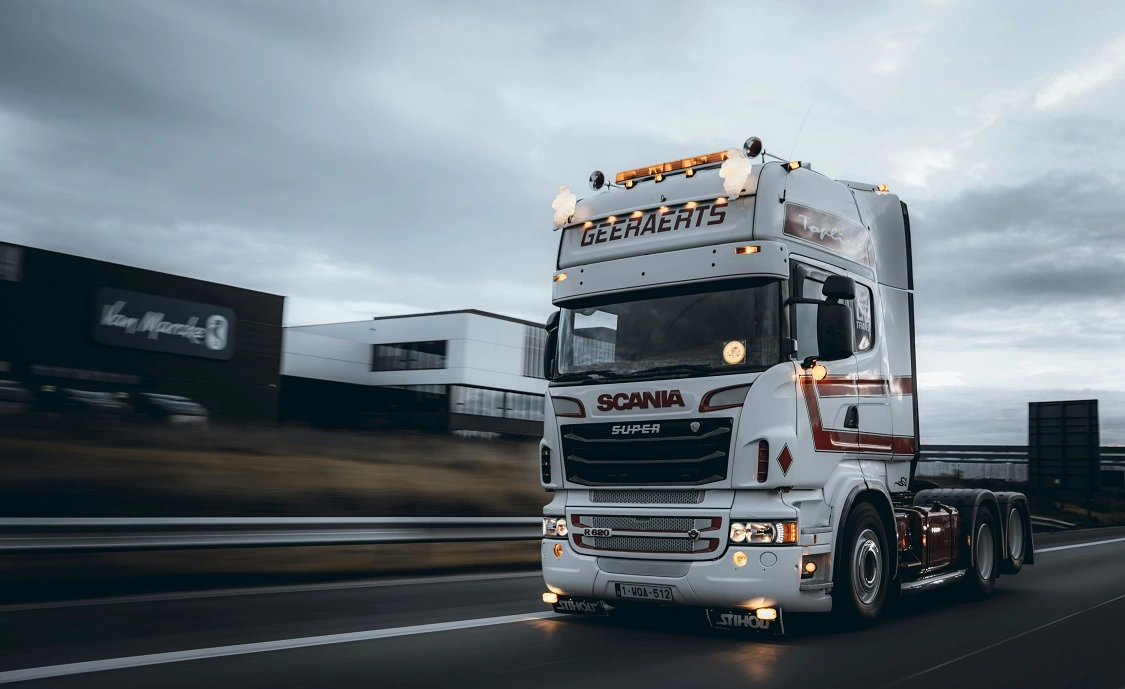
Image Source: https://unsplash.com/photos/a-large-truck-on-the-road-N5EPfCrEuy8
There’s something uniquely satisfying about hitting the highway with a line of trucks behind you, all headed to the same show or meet.

But a convoy that looks great also needs to run smoothly, and that starts with how well everyone can talk to each other on the road. Phones work fine for one-on-one calls, but they fall short when you need to coordinate lane changes, fuel stops, and route adjustments across a group of vehicles in real time.
Getting the right communication gear before your next convoy road trip can make the difference between a stressful, disorganized mess and a ride that feels effortless from start to finish.
Cell phones are great for daily life, but they have real limitations when you’re rolling with a group of trucks on the interstate. You can’t easily talk to five or ten people at once, and signal dead zones in rural stretches can leave you completely cut off.
Two-way radios solve both of those problems by giving everyone instant, push-to-talk access on the same channel.
Devices like Icom two-way radios are popular among convoy organizers because they offer clear audio and reliable range without depending on cell towers. A good handheld unit can reach several miles in open terrain, which is more than enough to keep your group connected on the highway.
Beyond range, radios let you broadcast a single message to everyone at once. If the lead truck spots construction ahead or the group needs to shift to a different exit, one quick call gets the word out instantly.
If you’re using consumer-grade radios, you’ll likely be on FRS or GMRS frequencies. FRS channels are license-free and work well for smaller groups over shorter distances. GMRS channels offer more power and better range, but they do require an FCC license in the United States.
For most convoy trips, GMRS is the better option. The license covers your entire immediate family and costs a relatively small fee for a ten-year term. The added power means your signal holds up better at highway speeds, especially when trucks are spread out over a mile or more.
It’s also worth agreeing on a primary and backup channel before you leave. If your main channel gets crowded with other users, having a preset backup means you can switch over without confusion.
Holding a radio while driving a truck is not practical and not safe. A good mounting bracket on the dash or center console keeps your radio within easy reach without taking your hands off the wheel.
Many drivers pair this with a speaker mic that clips to a seatbelt or shirt collar for completely hands-free operation.
If you prefer something even less intrusive, earpiece kits let you hear incoming transmissions without any cabin noise interference. These are especially useful if you’re running with the windows down or have a loud exhaust setup.
A dead radio is a useless radio. On a long convoy trip, your batteries will drain faster than you might expect, especially if the group is chatty. Pack at least one spare battery per radio and bring a vehicle charger so you can top off while driving.
Rechargeable lithium-ion batteries tend to last longer than standard alkaline packs, and they hold their charge better in hot weather. If your trip spans multiple days, a charging station at the hotel overnight keeps everyone powered up for the next leg.
Having the gear is only half the equation. Before the convoy rolls out, it helps to establish a few basic rules. Decide who calls out turns, lane changes, and stops. Agree on simple phrases that everyone understands so there’s no confusion when things happen fast.
Short radio checks at each fuel stop help verify that everyone’s gear is still working. It takes ten seconds and can save you from discovering mid-drive that someone has been off the air for the last fifty miles.
A well-organized convoy turns a regular road trip into something people remember and want to do again. The trucks get the attention, but the communication setup is what keeps everything running behind the scenes.
Invest in solid gear, set some ground rules before departure, and you’ll spend more time enjoying the drive than sorting out who missed the exit.

c10
2023 Ford F-100 Events 41st Annual Fall 4-Wheel Jamboree Nationals September 15-17 Indianapolis www.4wheeljamboree.com F-100 Supernationals September 21-23 Sevierville, TN www.f100supernationals.com Holley Intergalactic Ford Fest… Continue reading
F100 BG STAFF . October 20, 2023

Department
We get the same questions all the time when it comes to battery technology and buying choices. “What’s a gel battery?” “How are they better… Continue reading
Chris Hamilton . September 22, 2020
Industry News
Ford has been out of the mid-size truck business in America since they discontinued the Ranger back in 2011. But mid-size buyers choose smaller trucks… Continue reading
Jeff Zurschmeide . December 18, 2018

Features
The ’84 Chevy square-body masterpiece before your eyes appears like a lightly modified time capsule with a couple zeros on the left side of the… Continue reading
WES DUENKEL . October 09, 2020

Department
Interior Damping Kit ’88-’98 GM Truck/SUV Design Engineering, Inc. now offers a custom-cut solution specifically for 1988-’98 extended-cab GM pickups. Using a combination of proven… Continue reading
Chris Hamilton . October 18, 2022
Department
Our photographer spotlight this month is Jessica Roach. She is one very talented hard working women at a car show near you. Always looking for… Continue reading
Adam Johnson . April 01, 2022





Share Link